
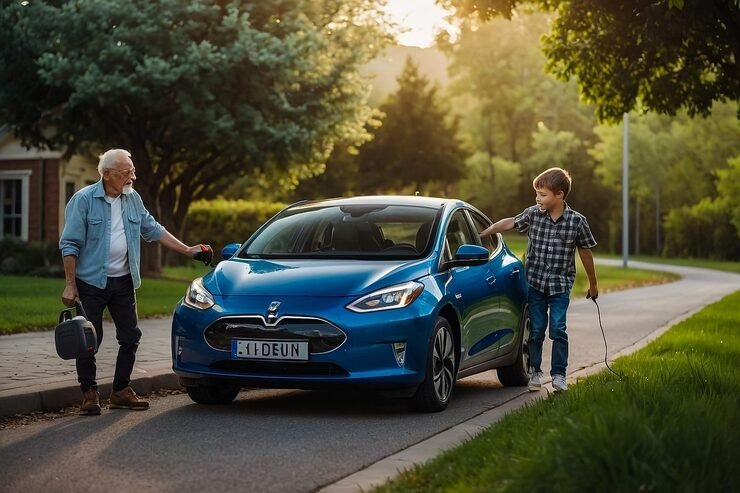
Buying an electric vehicle changes how you think about almost everything related to car ownership. Charging schedules replace gas station stops. Regenerative braking becomes second nature. And then comes the insurance question, which turns out to be significantly more complicated than most EV owners expect before they start shopping.
The honest truth is that insuring a hybrid or electric vehicle in 2026 is a different exercise than insuring a standard gas-powered car. The coverage gaps are different. The repair economics are different. The depreciation patterns are different. And the gap between the most expensive insurer and the least expensive insurer for the same EV profile is often 30% to 50%, which is dramatically wider than what you typically see in the standard auto insurance market.
This guide covers what actually matters for hybrid and EV owners shopping for coverage, which companies do it best, what coverage features most people never think to ask about, and how to make sure you are not paying for a policy designed for a vehicle you no longer own.
Why EV and Hybrid Insurance Works Differently
Understanding what drives EV insurance costs higher than standard auto premiums is not just interesting background information. It directly informs which coverage features you need and which insurer is most likely to price your specific vehicle fairly.
The Battery Cost Reality
A replacement battery pack for a modern electric vehicle costs between $8,000 and $20,000 depending on the make and model. For certain premium EVs, that figure can exceed $20,000. In a collision where the battery pack is damaged, which happens more frequently than most people realize even in moderate-speed impacts, the insurer faces a claim cost that has no real equivalent in standard auto insurance.
This is not an insurer complaint. It is simply the financial reality that makes EV insurance premiums higher than comparable ICE vehicle premiums, and it is the primary reason shopping aggressively across multiple insurers produces larger savings for EV owners than for standard vehicle owners.
Specialized Repair Requirements
Not every body shop is equipped or certified to repair an electric vehicle. High-voltage systems, battery management software, and proprietary electrical components require specialized training and equipment. Certified EV repair centers charge higher labor rates and frequently have longer wait times due to parts availability, particularly for newer or less common EV models.
Higher average repair costs produce higher average claim costs, which produce higher average premiums. The flip side is that insurers who have invested in EV claims handling processes tend to produce faster and more accurate resolutions than those who have not.
Home Charging Equipment Coverage Gaps
Most EV owners install a Level 2 home charging unit costing $500 to $2,000 for equipment plus $500 to $1,500 for installation. When that equipment is damaged by fire, theft, a power surge, or an event connected to a vehicle incident, coverage responsibility falls into a gray area between auto insurance and homeowners insurance that standard policies were not designed to address.
Some insurers have solved this explicitly. Others have not. Which category your insurer falls into only becomes clear at claim time, which is too late.
Depreciation Patterns That Affect Total Loss Payouts
Electric vehicles, particularly first-generation models and those from newer manufacturers, depreciate differently than comparable ICE vehicles. Battery degradation affects resale value in ways that standard actuarial depreciation tables do not fully capture. When an EV is totaled, the actual cash value payout may be lower than the owner expects based on their purchase price.
Gap insurance and new car replacement coverage are therefore more important financial considerations for EV owners than for most ICE vehicle owners, and they deserve explicit attention during any insurance shopping process.
How Much More Does EV Insurance Cost?
The premium difference between insuring an EV and insuring a comparable gas-powered vehicle varies by make, model, location, and insurer, but the pattern is consistent across the market.
Premium Comparison by Vehicle Type
| Vehicle Type | Example Model | Avg Annual Premium | vs Comparable ICE |
|---|---|---|---|
| Compact ICE sedan | Honda Civic | $1,680 | Baseline |
| Compact hybrid | Toyota Prius | $1,820 | Plus 8% |
| Compact EV | Chevy Bolt | $1,950 | Plus 16% |
| Midsize ICE sedan | Honda Accord | $1,740 | Baseline |
| Midsize hybrid | Toyota Camry Hybrid | $1,890 | Plus 9% |
| Midsize EV | Tesla Model 3 | $2,340 | Plus 34% |
| Luxury EV | Tesla Model S | $3,100 | Plus 78% vs luxury ICE |
| Full-size EV truck | Rivian R1T | $2,890 | Plus 45% vs F-150 |
These are national averages. What matters more than the average is the variation between insurers for the same vehicle. The difference between the cheapest and most expensive insurer for a Tesla Model 3 can be $800 to $1,200 per year for identical coverage. That spread is why comparison shopping matters more for EV owners than for almost any other driver category.
The Best Car Insurance Companies for Hybrid and Electric Vehicles in 2026
1. Tesla Insurance: Best for Tesla Owners in Available States
Tesla Insurance is genuinely different from every other product in this category, and not just because of the brand. The core innovation is the Safety Score pricing model, which uses real-time data from your vehicle’s sensors to price your policy based on how you actually drive rather than statistical assumptions about how people like you drive.
Hard braking events, aggressive turns, unsafe following distances, and forward collision warnings all feed into a daily Safety Score that directly influences your premium. Safe drivers can achieve premiums meaningfully below what any third-party insurer offers for the same vehicle and coverage.
The claims advantage is equally significant. Tesla Insurance works directly with Tesla’s certified service centers, meaning repair authorizations are faster, parts are sourced without the delays that third-party insurers face, and the total repair timeline is shorter. For anyone who has dealt with a standard insurer trying to find a certified EV repair facility, this integration is genuinely valuable.
Key Details:
- Currently available in: California, Texas, Illinois, Ohio, Virginia, Colorado, Oregon, Washington, Utah, Nevada, Arizona, Minnesota, Georgia, Florida, Tennessee, New York, Maryland, and expanding
- Premium basis: Real-time Safety Score from onboard vehicle data
- Charging equipment: Covered in most available states
- Claims process: Direct Tesla service center integration
Pros:
- Most accurate pricing for Tesla-specific risk profile
- Fastest claims resolution for Tesla vehicles
- Safe drivers have direct control over their premium through daily Safety Score
- No third-party delays in parts sourcing or repair authorization
Cons:
- Tesla vehicles only
- Not yet available in all states
- Requires continuous driving data monitoring
- Limited to Tesla’s service center network
Best for: Any Tesla owner in a covered state. This should always be the first quote you get before comparing anything else.
2. State Farm: Best Overall Coverage for Non-Tesla EVs
For EV owners who do not drive a Tesla and want comprehensive coverage from a financially stable major insurer with genuine EV-specific features, State Farm is the most consistently strong recommendation across different vehicle types and geographic markets.
The standout feature is charging equipment coverage built into comprehensive coverage in most states. When your home charging equipment is damaged in a covered event, State Farm’s policy addresses it rather than leaving you to argue about whether auto or homeowners coverage applies. That clarity at claim time is worth more than the headline premium number suggests.
State Farm’s Drive Safe and Save telematics program is also particularly well-suited to EV driving patterns. Smooth acceleration and regenerative braking, which are natural characteristics of EV operation, score positively in the program’s algorithm, meaning EV drivers frequently achieve higher discount percentages than ICE vehicle drivers with equivalent care and attention.
Key Details:
- Available in: All 50 states
- Charging equipment coverage: Built into comprehensive in most states
- New car replacement: Available in first model year
- Telematics: Drive Safe and Save with up to 30% discount
- Financial strength: A++ from AM Best
Pros:
- Charging equipment coverage addresses a real gap that many competitors leave unresolved
- Drive Safe and Save rewards EV driving patterns well
- Nationwide availability and local agent network
- Excellent financial stability and claims payment reputation
Cons:
- Base rates not always lowest before discounts
- Technology component coverage not explicitly addressed in standard policy language
- No Tesla-level service center integration
Best for: Non-Tesla EV owners who want comprehensive coverage including charging equipment protection from a financially stable, nationally available insurer.
3. GEICO: Best for Hybrid Vehicle Owners Prioritizing Price
Hybrid vehicles occupy an interesting middle ground in the insurance market. They are more complex mechanically than ICE vehicles due to dual drivetrain systems, but they do not carry the full premium burden of a pure EV because the battery pack is smaller and repair costs are lower.
GEICO’s pricing model for hybrids is consistently competitive across markets. In direct comparison testing across multiple driver profiles and hybrid vehicle types, GEICO comes in at or near the lowest available rate more frequently than any other major insurer for hybrid-specific profiles.
The mechanical breakdown insurance add-on is worth mentioning specifically for hybrid owners. Available for vehicles under 15 months old with fewer than 15,000 miles, it provides coverage for mechanical failures that fall outside standard warranty coverage. The complex dual drivetrain of a hybrid creates more potential failure points than a standard ICE vehicle, making this add-on more valuable for hybrid owners than for buyers of conventional cars.
Key Details:
- Available in: All 50 states
- Mechanical breakdown insurance: Available for new hybrids
- Telematics: DriveEasy with discount potential
- Financial strength: A++ from AM Best
Pros:
- Consistently competitive pricing for hybrid vehicles
- Mechanical breakdown insurance is valuable for complex hybrid drivetrains
- Fast online quoting process
- Strong financial stability
Cons:
- No explicit EV charging equipment coverage
- No direct service center integration for any brand
- Customer service satisfaction below some competitors
Best for: Hybrid vehicle owners who prioritize premium competitiveness and want mechanical breakdown protection for complex drivetrain components.
4. Progressive: Best for EV Owners With Prior Violations or Claims
Progressive’s willingness to cover a broader range of driver profiles makes them the most accessible major insurer for EV owners whose driving record is not pristine. An at-fault accident, a speeding ticket, or a period of coverage lapse can make other major insurers significantly less competitive or unwilling to write the policy at all.
The Snapshot telematics program gives EV drivers a genuine mechanism to demonstrate current safe driving behavior and reduce the premium impact of prior record events over time. Because EV driving naturally tends to produce smooth, measured driving patterns, Snapshot results for EV owners are often better than for comparable ICE vehicle drivers.
Progressive’s gap insurance product is also one of the clearest and most explicitly structured for EVs. Given the depreciation risk on newer EV models, particularly those from manufacturers with rapidly improving year-over-year battery technology, gap coverage is a practical necessity for financed EVs that many other insurers handle less explicitly.
Key Details:
- Available in: All 50 states
- Gap insurance: Explicitly structured for EV total loss scenarios
- Telematics: Snapshot with up to 30% discount
- Financial strength: A+ from AM Best
Pros:
- Most accessible major insurer for EV owners with prior violations
- Clear gap insurance product for financed EVs
- Snapshot gives current safe drivers a path to lower premiums
- Name Your Price tool helps budget-conscious EV owners find workable coverage
Cons:
- Base rates higher than GEICO for clean-record profiles before discounts
- No EV-specific charging equipment coverage
- Snapshot can raise rates if driving behavior scores poorly
Best for: EV owners with less-than-perfect driving records who want a major insurer and a telematics path to lower rates through demonstrated safe driving.
5. Nationwide: Best Pay-Per-Mile Option for Low-Mileage EV Owners
Here is something the standard EV insurance conversation almost never addresses: many electric vehicle owners drive significantly fewer miles per year than the national average of 14,000 miles. When your daily commute is 12 miles each way and you charge at home overnight, annual mileage of 6,000 to 8,000 miles is completely normal. Paying a premium calculated on assumed 14,000 miles when you drive half that is a structural overpayment that compounds year after year.
Nationwide’s SmartMiles pay-per-mile program charges a low base monthly rate plus a per-mile charge, meaning your total annual premium directly reflects your actual driving distance. The savings for genuinely low-mileage EV owners can reach 30% to 50% compared to standard policy pricing.
The SmartRide telematics program adds another layer of discount potential with up to 40% off for safe driving behavior, the highest maximum telematics discount among major insurers. Combining SmartMiles with SmartRide behaviors produces a premium structure that accurately prices both how much and how safely you drive.
Key Details:
- Available in: Most states
- SmartMiles: Pay-per-mile for low-mileage EV drivers
- SmartRide: Up to 40% telematics discount
- Vanishing deductible: $100 reduction per claim-free year
- Financial strength: A+ from AM Best
Pros:
- Pay-per-mile pricing is the fairest structure for EV owners who drive locally
- Highest maximum telematics discount among major insurers
- Vanishing deductible rewards ongoing safe driving progressively
- Strong claims satisfaction ratings
Cons:
- SmartMiles requires comfort with mileage tracking device
- Base pricing without telematics not always competitive for higher-mileage drivers
- No explicit EV charging equipment coverage in standard policy
Best for: EV owners who drive under 8,000 miles annually and want a premium that accurately reflects actual driving rather than assumed average mileage.
6. Allstate: Best Explicit Charging Equipment Protection
Allstate addresses the home EV charging equipment gap more directly than most major competitors through an explicit charging equipment endorsement that can be added to your auto or homeowners policy. The endorsement specifically covers your charging station against damage from fire, theft, vandalism, and power surges, removing the ambiguity that standard policies leave about which coverage applies and when.
The Drivewise telematics program is also distinctive in offering cash back rewards for safe driving rather than just a premium discount. For EV owners who drive smoothly by nature of their vehicle’s operating characteristics, the cash back element adds tangible value beyond what a standard discount-only telematics program provides.
Key Details:
- Available in: All 50 states
- Charging equipment endorsement: Explicit add-on for home EV charging stations
- Drivewise: Cash back rewards plus rate discounts
- Deductible Rewards: $100 reduction per claim-free year
- Financial strength: A+ from AM Best
Pros:
- Most explicit charging equipment coverage among major national insurers
- Cash back rewards are unique in the major insurer telematics landscape
- Deductible Rewards benefits clean-record EV owners progressively over time
- Nationwide agent availability
Cons:
- Base rates on the higher end before discounts
- Claims satisfaction scores mixed compared to top competitors
- Full benefit realization requires active program engagement
Best for: EV owners who want explicit charging equipment protection and value cash back rewards for safe driving on top of premium discounts.
7. Farmers: Best OEM Parts Coverage for Proprietary EV Components
Standard auto insurance policies give insurers the right to use aftermarket or remanufactured parts when repairing your vehicle. For a conventional ICE car, this is a modest concern. For an EV with proprietary battery management systems, charging controllers, and software components that are deeply integrated into how the vehicle operates, non-original parts can affect performance, software compatibility, and in some cases manufacturer warranty status.
Farmers offers an OEM parts coverage endorsement that requires repairs to be made with original manufacturer parts. This endorsement matters more for EVs than for almost any other vehicle category, and it is one of the coverage features that genuinely differentiates Farmers for EV owners who understand how their vehicle works.
Key Details:
- Available in: Most states
- OEM parts coverage: Available as endorsement
- New car replacement: Available
- Signal telematics: Up to 15% discount
- Financial strength: A from AM Best
Pros:
- OEM parts endorsement ensures proprietary EV components are replaced correctly
- Highly customizable policy structure
- New car replacement available for first-year EV owners
- Good agent support for coverage customization
Cons:
- Not available in all states
- Telematics discount lower than some competitors
- Premiums higher than purely digital competitors
Best for: EV owners who understand the importance of OEM components in their vehicle’s integrated systems and want insurance that explicitly protects that requirement.
Comparison Table: Best EV and Hybrid Insurance by Insurer
| Insurer | Best For | EV-Specific Feature | Avg Annual Premium | AM Best |
|---|---|---|---|---|
| Tesla Insurance | Tesla owners | Safety Score, service integration | $1,800 to $2,600 | N/A |
| State Farm | Overall EV coverage | Charging equipment under comprehensive | $2,000 to $2,800 | A++ |
| GEICO | Hybrid pricing | Mechanical breakdown insurance | $1,900 to $2,600 | A++ |
| Progressive | Prior violations | Clear EV gap insurance | $2,100 to $3,000 | A+ |
| Nationwide | Low-mileage EVs | SmartMiles pay-per-mile | $1,400 to $2,200 | A+ |
| Allstate | Charging equipment | Explicit charging endorsement | $2,200 to $3,100 | A+ |
| Farmers | OEM components | OEM parts endorsement | $2,100 to $2,900 | A |
Coverage Features EV Owners Should Ask About Before Buying
Battery Coverage Confirmation
Ask your insurer directly: does your policy cover battery pack damage from a collision? What about damage from a charging incident or an electrical fault? Get the answer in writing before you need it, not after.
Charging Equipment Coverage
Ask whether your policy covers home charging equipment when damaged in a covered event. Ask whether coverage applies when the equipment is physically connected to the vehicle versus when it is not. Ask whether a separate homeowners endorsement is required.
New Car Replacement vs Actual Cash Value
For a new EV, the difference between these two coverage types can be thousands of dollars in the first two to three years of ownership. New car replacement ensures a total loss pays for an equivalent new vehicle rather than the depreciated market value of your current one.
OEM Parts Requirement
Without this endorsement, your insurer can use aftermarket parts in repairs. For EV components that are deeply integrated with vehicle software and battery management systems, this distinction matters in ways it simply does not for conventional vehicles.
Rental Reimbursement Limits During Extended EV Repairs
EV repairs at certified facilities take longer than standard repairs. Standard rental reimbursement limits of $30 to $50 per day become inadequate quickly during a three to four week repair timeline. Request a higher daily limit when setting up your policy.
Discounts EV Owners Frequently Miss
Green Vehicle or Hybrid Discount
Several insurers offer explicit discounts of 5% to 10% for owning an EV or hybrid. This discount is not always automatically applied. Ask specifically whether it exists and whether it is currently on your policy.
Telematics Enrollment From Day One
EV driving patterns naturally align with what telematics programs reward. Smooth acceleration from electric motors and regenerative braking that reduces hard stop events both score positively. Enrolling from the beginning of your policy rather than adding it later maximizes the discount period.
Accurate Mileage Estimate
Many EV owners drive fewer miles than their policy reflects because their mileage estimate was set when they owned an ICE vehicle and was never updated. Correcting this on file with your insurer can produce an immediate premium reduction.
A full breakdown of every discount category worth asking about is covered in the guide on 25 types of car insurance discounts you should ask about, which walks through every available category including EV-specific options that most drivers never claim.
What to Do Before Getting Your First EV Insurance Quote
Document your vehicle fully including battery size in kWh, range, software version, and all advanced driver assistance features. Some insurers apply safety technology discounts for specific features.
Note your home charging setup and confirm whether your Level 2 charger is permanently hardwired or portable, as this affects which policy covers damage in different scenarios.
Review your actual annual mileage post-EV ownership rather than using your pre-EV estimate.
Assess your gap coverage need based on your loan balance versus current vehicle market value, particularly important for EVs with unpredictable depreciation.
Get at least five quotes using identical coverage specifications. The pricing variation for EVs across insurers is larger than for almost any other vehicle category, making comparison shopping proportionally more valuable. The compare cheap car insurance quotes from top insurers tool makes this process significantly more efficient than contacting each company individually.
Pros and Cons of Insuring an Electric or Hybrid Vehicle
Pros
- Telematics programs reward EV driving patterns with above-average discounts
- Green vehicle discounts available at multiple major insurers
- New EV-specific coverage products are emerging rapidly
- Low-mileage pay-per-mile programs benefit EV owners who drive primarily locally
- Tesla Insurance offers uniquely integrated coverage for Tesla owners
Cons
- Higher base premiums than comparable ICE vehicles
- Not all insurers have resolved charging equipment and battery coverage gaps
- Repair network limitations can extend claim timelines
- Faster depreciation on some models reduces actual cash value at total loss
- Technology component coverage is inconsistently addressed across the market
Frequently Asked Questions
Q1: Why is electric car insurance more expensive than regular car insurance?
Three primary factors drive the premium difference. First, battery replacement costs between $8,000 and $20,000 dramatically increase the average claim cost for EVs versus comparable ICE vehicles. Second, specialized repair requirements mean fewer certified shops, higher labor rates, and longer repair timelines, all of which increase the cost of settling a claim. Third, higher vehicle purchase prices increase the dollar amount of total loss settlements. The gap is real and is reflected in market pricing across all major insurers, though the extent of the gap varies significantly between companies and is narrowing as EV repair infrastructure expands.
Q2: Does my car insurance cover home EV charging equipment?
The honest answer is that it depends entirely on your insurer and policy, and you should ask specifically rather than assuming. Standard auto comprehensive coverage may cover charging equipment physically connected to your vehicle during a covered loss. Permanently installed home charging equipment is more likely to fall under homeowners or renters insurance. Portable charging equipment may fall under either depending on where it is when damaged. State Farm covers charging equipment under comprehensive in most states. Allstate offers an explicit endorsement for it. Many other insurers leave this genuinely ambiguous until claim time.
Q3: Is Tesla Insurance significantly better than third-party options for Tesla owners?
For safe drivers in covered states, Tesla Insurance frequently produces the most competitive premium because the Safety Score pricing model rewards actual driving behavior rather than statistical profile assumptions. The claims process advantage through direct Tesla service center integration is real and meaningful, particularly for owners who have experienced the delays that occur when a third-party insurer needs to find and authorize a certified Tesla repair facility. The main reasons to consider third-party coverage are if you are in a state where Tesla Insurance is not yet available, if your driving patterns score poorly in the Safety Score system, or if multi-policy bundle discounts from combining home and auto insurance with one carrier produce better total savings.
Q4: What is gap insurance and do EV owners need it more than ICE vehicle owners?
Gap insurance covers the difference between what you owe on your auto loan and what your insurer pays in a total loss scenario based on the vehicle’s actual cash value. EV owners with financed vehicles generally need gap coverage more than comparable ICE vehicle owners for two reasons: EVs often carry higher purchase prices and therefore larger loan balances, and some EV models depreciate faster than equivalent ICE vehicles due to rapidly improving battery technology in newer model years that reduces the relative value of older ones. If your loan balance currently exceeds your vehicle’s market value, gap insurance is protecting you from paying the difference out of pocket after a total loss.
Q5: What discounts are EV owners most likely missing on their current policy?
The three most commonly unclaimed discounts for EV owners are the green vehicle or hybrid discount (which must be explicitly requested at most insurers), the telematics program enrollment discount (which EV driving patterns tend to earn at above-average rates), and the low-mileage discount reflecting reduced annual driving that many EV owners never updated from their pre-EV mileage estimate. Beyond these, the broader guide on how to lower your car insurance premium covers additional strategies applicable to EV owners including deductible optimization, bundle discounts, and defensive driving course discounts that most drivers never claim.
Conclusion
The EV and hybrid insurance market in 2026 is more developed than it was three years ago, but it is still catching up to the vehicles it covers. Coverage gaps around charging equipment, battery replacement, OEM parts requirements, and technology component protection exist at most major insurers and only become visible when a claim happens.
The insurers who have done the most to close those gaps are Tesla Insurance for Tesla owners, State Farm for comprehensive charging equipment coverage, Allstate for explicit charging equipment endorsements, and Farmers for OEM parts protection. Nationwide wins for low-mileage EV owners through SmartMiles. GEICO leads on hybrid pricing with mechanical breakdown protection. Progressive handles the broadest range of EV owner profiles including those with imperfect records.
Getting the right coverage at the right price requires two things: understanding which coverage features your specific vehicle and situation actually need, and comparing enough insurers to find who prices that profile most competitively. For EV owners, both steps matter more than they do for anyone else in the auto insurance market.